








Login to Internet banking
A brand-new experience - smarter, faster, and secured





BRAVO (Auto Sweep)
Convert the idle funds in your current account into a fixed deposit with the BRAVO feature.
Know More

Zero Forex Markup Current Account
Maximise your savings and boost profitability with our Zero Forex Markup current accounts
Know More
BRAVO (Auto Sweep)
Convert the idle funds in your current account into a fixed deposit with the BRAVO feature.
Know More

You gain a dedicated partner committed to helping you reach your full potential and achieve new heights
Know More






Enjoy Zero Forex on all IDFC FIRST Bank Credit Cards
Save more on all international spends
Know More

A Card that Powers your Savings & Lifestyle
IDFC FIRST Bank HPCL Credit Card









Most Searched
Earn up to 7% interest on your Savings Account
Open Account Now
Download our app
Get instant help for all your queries in one place
Unlock features, exclusively available
only on the IDFC FIRST Bank app
Trusted by 1.2+ million Indians.


4.8

4.8

Tools & Calculators
Privilege Program



Tools & Calculators
Savings Account
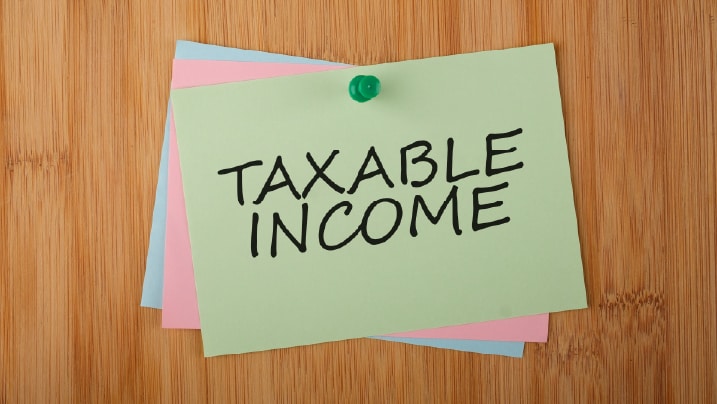
 Gross income includes all earnings before deductions, while taxable income is what remains after exemptions and deductions.
Salary, bonuses, and allowances are taxable, but deductions like HRA and retirement contributions can reduce liability.
Rental income is taxable after deducting municipal taxes, home loan interest, and a 30% standard deduction.
Profits from selling assets like property or stocks are taxed as short- or long-term capital gains depending on holding period.
The Income Tax Act specifies that an individual's earnings fall under different income heads. Your income tax liability is calculated on the basis of the type of income; the types of income tax return (ITR) you file also depend on the type of earnings.
To file your ITR correctly, you must know what type of income you are earning, how tax is calculated on such a source of income, and which ITR to file at the end of the year.
Let's explore this in detail.
Section 14 of the Income Tax Act defines five broad types of income under which earnings can be categorised. The income you earn during a financial year is categorised under one of the following five heads of income.
Salary is any monetary compensation received as remuneration for services offered. Such compensation must be based on an agreement between the payer and the payee, with an employer-employee relationship.
The salary amount can have more than one component, including, but not limited to, basic salary, allowances, leave encashment, pension, gratuity, etc. Some of the allowances paid as a part of the salary may be exempt. These include house rent allowance (HRA), medical allowance, and leave travel allowance.
Your salary for March is included even if it is paid in April, i.e., the next financial year. If you receive April's salary as an advance in March, it will be included even though it is from the upcoming financial year.
Your employer uses your salary information and the investment deductions you may have declared to estimate your tax liability. They are mandatorily required to deduct TDS from the salary disbursed. The salary income minus exemptions are added in the ITR against income from salary.
Also read: https://www.idfcfirst.bank.in/finfirst-blogs/finance/why-social-media-influencer-need-to-pay-tax
If you have earned any rental income from a house or a commercial property during the year, it will fall under this type of income tax head. If you have more than one house property, only one is considered self-occupied, while all the others are treated as let-out properties.
The annual estimated "lettable" value or the rent received/receivable is included as income from the let-out property. House property is taxable when,
• The house property consists of a house, building or appurtenant land
• The taxpayer is the owner of the property
• The property is not used for carrying out the taxpayer's business or professional practice
Income from house property is eligible for the following deductions:
• Standard deduction of 30% of the net annual value
• Interest paid against a home loan
• Municipal taxes
• Unrealised rent
After the above deductions, the rental income is added to the ITR under the head 'Income from House Property'. If the rental income in a financial year is more than Rs 2.4 lakh, 10% of the rent is deducted as TDS (5% for individuals and HUFs, if rent is more than Rs 50,000 per month).
Any profit you make from a business or profession during the financial year is categorised as Income from profits and gains of a business or profession. Sub-sections of sections 28, 41 and 43 define the incomes chargeable to tax under this head. If the taxpayer receives any bonus, salary or profit in the capacity of a partner in a business, it will fall under this source of income head.
Before calculating the tax on your business or professional Income, you can deduct the relevant business expenses while following the provisions of sections 30 to 37 of the Income Tax Act. The profit earned from a business or profession is included under this type of income head while calculating the taxpayer’s net taxable Income.
Income from the sale of any movable or immovable capital asset falls under capital gains. It could be classified as short-term capital gain (STCG) and long-term capital gain (LTCG). Gains from the sale of an asset held for 36 months or less are considered STCG. The period is 24 months or less for the sale of immovable properties and 12 months or less for securities.
Gains from the sale of an asset held for more than 36 months fall under LTCG. For the sale of immovable properties, the duration is more than 24 months and more than 12 months in the case of securities.
• LTCG on securities is taxable at 10%. No tax is applicable if the capital gain is less than Rs 1 lakh
• LTCG on any other asset is 20%
• STCG is taxed at 15% if securities transaction tax (STT) is applicable
• STCG is added to the taxable Income of the assessee and taxed as per the income tax slab if STT is not applicable
This includes any other source of Income apart from the four income heads specified above. Interest income, the commission received, lottery winnings, dividends, gifts, etc., fall under this type of income head.
The Income from other sources is added to the net taxable Income of the assessee and taxed as per the slab. TDS deduction varies for the different types of Income from other sources. For instance, TDS on lottery winnings is 30%, while interest income is 10%.
Also read: https://www.idfcfirst.bank.in/finfirst-blogs/finance/is-tax-refund-amount-taxable
Once you ascertain your type of Income, calculating your tax liability becomes easier. There are various ways in which you can maximise your tax savings.
Opening an IDFC FIRST Bank savings account makes investing in tax-saver fixed deposits, tax-deductible ELSS mutual funds, buying life insurance and much easier. Open your IDFC FIRST Bank Savings Account today in just a few clicks and enjoy many benefits, including high-interest rates and monthly interest credits.
Disclaimer
The contents of this article/infographic/picture/video are meant solely for information purposes. The contents are generic in nature and for informational purposes only. It is not a substitute for specific advice in your own circumstances. The information is subject to updation, completion, revision, verification and amendment and the same may change materially. The information is not intended for distribution or use by any person in any jurisdiction where such distribution or use would be contrary to law or regulation or would subject IDFC FIRST Bank or its affiliates to any licensing or registration requirements. IDFC FIRST Bank shall not be responsible for any direct/indirect loss or liability incurred by the reader for taking any financial decisions based on the contents and information mentioned. Please consult your financial advisor before making any financial decision.
The features, benefits and offers mentioned in the article are applicable as on the day of publication of this blog and is subject to change without notice. The contents herein are also subject to other product specific terms and conditions and any third party terms and conditions, as applicable. Please refer our website www.idfcfirst.bank.in for latest updates.


You will earn