









Login to Internet banking
A brand-new experience - smarter, faster, and secured


BRAVO (Auto Sweep)
Convert the idle funds in your current account into a fixed deposit with the BRAVO feature.
Know More

Zero Forex Markup Current Account
Maximise your savings and boost profitability with our Zero Forex Markup current accounts
Know More
BRAVO (Auto Sweep)
Convert the idle funds in your current account into a fixed deposit with the BRAVO feature.
Know More
You gain a dedicated partner committed to helping you reach your full potential and achieve new heights
Know More



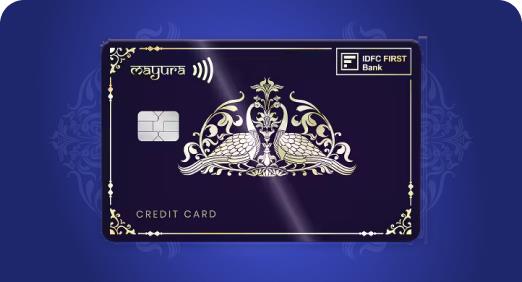
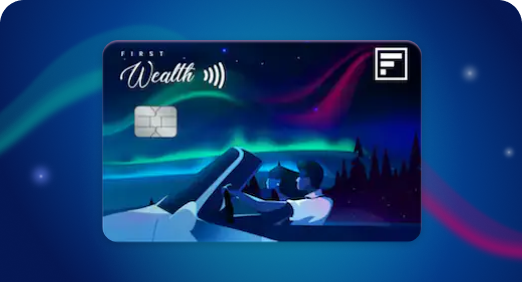
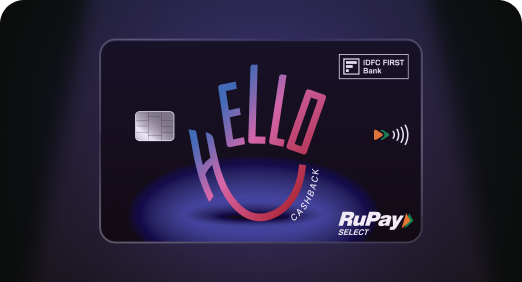

Enjoy Zero Forex on all IDFC FIRST Bank Credit Cards
Save more on all international spends
Know More
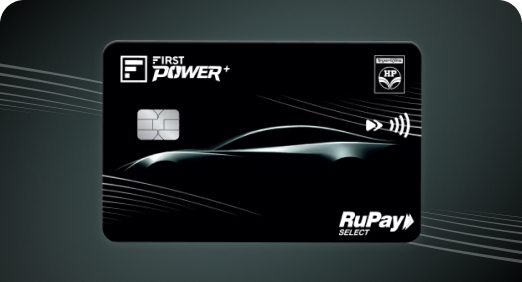
A Card that Powers your Savings & Lifestyle
IDFC FIRST Bank HPCL Credit Card









Most Searched
Earn up to 7% interest on your Savings Account
Open Account Now
Download our app
Get instant help for all your queries in one place
Unlock features, exclusively available
only on the IDFC FIRST Bank app
Trusted by 1.2+ million Indians.


4.8

4.8

Tools & Calculators
Privilege Program



Tools & Calculators

Unlock features, exclusively available
only on the IDFC FIRST Bank app
Personal Loan
 An NOC (No Objection Certificate) letter is issued by a bank once a loan is fully repaid, confirming that no outstanding debts remain.
This document is crucial as it formally concludes the loan repayment cycle and eliminates any future legal issues.
To obtain an NOC, you can request it through your bank’s customer portal, via email, or by mail.
It’s important to ensure the bank has your current address to avoid missing the NOC. If not received, you should contact your lender directly to request it.
An NOC (No Objection Certificate) letter is issued by a bank once a loan is fully repaid, confirming that no outstanding debts remain.
This document is crucial as it formally concludes the loan repayment cycle and eliminates any future legal issues.
To obtain an NOC, you can request it through your bank’s customer portal, via email, or by mail.
It’s important to ensure the bank has your current address to avoid missing the NOC. If not received, you should contact your lender directly to request it.
Clearing your EMIs is a big milestone, but your loan isn’t fully closed until you receive your No Objection Certificate (NOC). This document helps update your credit record, confirms that no dues remain, and is often needed for things like asset transfers. Missing it can lead to small but avoidable complications later.
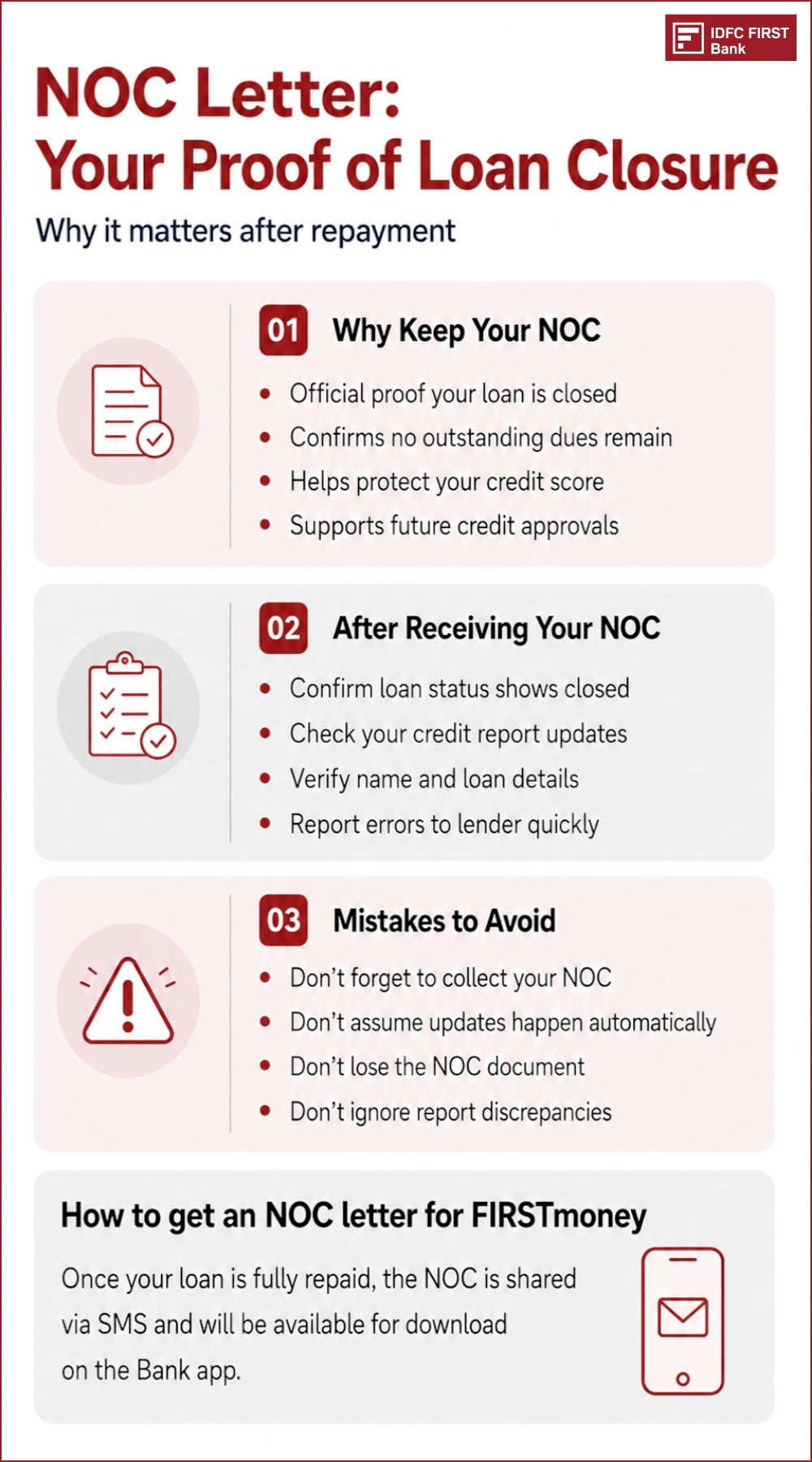
Read on to understand why it matters and how to get it.
An NOC is a letter you receive from a bank upon the closure of your loan. It states that all outstanding debts have been paid in full and that no other payments are due on a specific date.
Here’s why having an NOC letter is so important:
1. Proof of loan closure
An NOC letter serves as official proof that you have fully repaid your loans, like home loans, car loans, and personal loans, and no outstanding dues remain. These documents confirm the closure of the loan account, protecting you, the borrower, from future claims by the lender and securing asset ownership.
2. Impact on your credit score
Once the NOC is issued, lenders report the loan as “closed” to credit bureaus. This update helps maintain or improve your credit score by reflecting timely repayment and debt closure.
3. Easier access to future credit
A clean repayment record backed by an NOC signals responsible credit behaviour. This improves your chances of getting approved for future loans or credit cards, often on better terms.
Once your loan is fully repaid, the NOC is shared via SMS and will be available for download on the Bank app.
Before initiating your request, it is important to keep the following documents ready to avoid delays:
An NOC letter is a critical document that confirms full repayment of your personal loan. Failing to obtain it could lead to several complicated situations:
Without an NOC, it is difficult to prove that you have fully repaid your debt. This could result in your lender mistakenly pursuing you for outstanding dues.
The lender might initiate legal proceedings, and defending such claims could be challenging for you without an NOC letter.
If the loan closure is not reported to credit bureaus, your personal loan may appear as an active or unpaid loan, negatively impacting your credit score and making it harder to avail of future loans.
Receiving your No Objection Certificate is not the final step. You should verify a few details to avoid future issues. Here’s a quick checklist to follow:
1. Has your loan account been marked as closed?
Log in to your lender’s portal or app and confirm that the loan status reflects “closed” or “settled” with zero outstanding balance.
2. Is your credit report updated?
Check your credit report with bureaus to ensure the loan is reflected as closed. This update may take a few weeks, but it’s important to follow up if delayed.
3. Are all NOC details accurate?
Verify that your name, loan account number, loan type, and closure confirmation are correctly mentioned in the document.
4. Have you addressed any discrepancies?
If you notice errors, such as an active loan status or incorrect details, raise a request with your lender immediately and, if required, initiate a correction with the credit bureau.
Taking a few minutes to complete this checklist can prevent complications when applying for future credit.
Many borrowers assume that repaying the last EMI is the end of the process. In reality, overlooking a few key steps can lead to avoidable problems later. Here are some common mistakes to watch out for:
1. Not collecting the NOC
Failing to obtain your NOC leaves you without formal proof of loan closure, which can create issues if disputes arise.
2. Assuming the closure is automatic
While lenders do initiate closure processes, you must confirm that your loan account status and credit report are updated correctly.
3. Losing the NOC document
Misplacing this document can make it difficult to prove repayment later. Although duplicates can be requested, the process may take time and effort.
4. Ignoring credit report updates
Even after full repayment, delays or errors in credit bureau reporting can affect your credit score if not addressed promptly.
To avoid these issues, it helps to choose a lending experience that offers transparency and easy access to documents. With digital-first solutions like the IDFC FIRST Bank FIRSTmoney Personal Loan, you can track your loan lifecycle, access important documents such as your NOC, and stay informed at every stage, from disbursal to closure.
If you lose your NOC letter, you must immediately contact your lender to request a duplicate. You may have to submit a written application, provide ID proof and share loan details for verification. Make sure that you follow up until you receive your duplicate copy, as the NOC is a crucial document for updating your credit history and preventing future disputes.
An NOC is more than just random paperwork; it is proof that you have fully repaid your loan. Because it plays a key role in maintaining your credit score, you need to make sure you handle it correctly with some quick tips:
An NOC serves as proof of the official closure of your personal loan. This certificate is key in safeguarding you from future liabilities, which is why you need to request one after completing your loan tenure. IDFC FIRST Bank provides digital access to this document, helping you seamlessly close your loan without any hassles.
You need to contact your lender immediately and raise a request for a duplicate. You might need to submit a written request and provide your ID proof for verification.
Your loan NOC should mention your name, loan account number, type of loan, and confirmation of full repayment.
The first NOC is typically issues free of charge. However, a duplicate NOC may incur nominal fees.
Once your loan is marked close and your NOC is issued, it could positively impact your credit score over time.
An NOC in banking is a short letter from the lender that states your loan has been fully settled and nothing more is payable on that account. It mentions the loan number, closure date, and any security release notes. You keep it as formal confirmation that the relationship on that facility has ended. If questions arise later, the NOC acts as a reference for you and any institution reviewing records.
It serves as documentary proof that the loan is closed, which helps during credit bureau updates and future verifications. If a vehicle or asset was hypothecated, the NOC supports removing that charge from records with the relevant authority. It also helps resolve disputes about residual interest or small charges. Keeping a signed or digitally verifiable NOC gives you an auditable trail if another bank, employer, or auditor asks for confirmation.
You will receive the NOC letter via SMS, and you can download it via the Bank app as well.
Yes. An NOC from the lender is essential as proof of full repayment and is needed for post-closure steps like removing hypothecation and ensuring your credit report updates correctly. Keep the closure confirmation and NOC safely.
The contents of this article/infographic/picture/video are meant solely for information purposes. The contents are generic in nature and for informational purposes only. It is not a substitute for specific advice in your own circumstances. The information is subject to updation, completion, revision, verification and amendment and the same may change materially. The information is not intended for distribution or use by any person in any jurisdiction where such distribution or use would be contrary to law or regulation or would subject IDFC FIRST Bank or its affiliates to any licensing or registration requirements. IDFC FIRST Bank shall not be responsible for any direct/indirect loss or liability incurred by the reader for taking any financial decisions based on the contents and information mentioned. Please consult your financial advisor before making any financial decision.
The features, benefits and offers mentioned in the article are applicable as on the day of publication of this blog and is subject to change without notice. The contents herein are also subject to other product specific terms and conditions and any third party terms and conditions, as applicable. Please refer our website www.idfcfirst.bank.in for latest updates.


Check the latest rates.

Know your total loan cost.

Estimate your EMI instantly.

Compare EMIs for multiple loan types.

See why your score matters.