









Login to Internet banking
A brand-new experience - smarter, faster, and secured





You gain a dedicated partner committed to helping you reach your full potential and achieve new heights
Know More

BRAVO (Auto Sweep)
Convert the idle funds in your current account into a fixed deposit with the BRAVO feature.
Know More
Zero Forex Markup Current Account
Maximise your savings and boost profitability with our Zero Forex Markup current accounts
Know More









A Card that Powers your Savings & Lifestyle
IDFC FIRST Bank HPCL Credit Card









Most Searched
Earn up to 7% interest on your Savings Account
Open Account Now
Download our app
Get instant help for all your queries in one place
Unlock features, exclusively available
only on the IDFC FIRST Bank app
Trusted by 1.2+ million Indians.


4.8

4.8

Tools & Calculators
Privilege Program



Tools & Calculators

Unlock features, exclusively available
only on the IDFC FIRST Bank app
Savings Account
 Average Monthly Balance or AMB is the average amount that you as a savings account holder must keep in your savings account every month, to avoid facing non maintenance charges.
Most banks, including IDFC FIRST Bank, calculate AMB using the end-of-the-day balance or daily closing balances in savings accounts, which are summed up over a given month to determine the monthly average balance.
The closing day balances for a 31-day month are totalled, and the sum is divided by 31 to get the average.
Average Monthly Balance or AMB is the average amount that you as a savings account holder must keep in your savings account every month, to avoid facing non maintenance charges.
Most banks, including IDFC FIRST Bank, calculate AMB using the end-of-the-day balance or daily closing balances in savings accounts, which are summed up over a given month to determine the monthly average balance.
The closing day balances for a 31-day month are totalled, and the sum is divided by 31 to get the average.
For many savings account holders, questions about average monthly balance (AMB) surface when reviewing account statements or deciding whether their account type suits their financial habits.
According to standard banking terminology, the average monthly balance is the average amount that must be maintained in a savings account each month. When the required AMB threshold set by the bank’s internal policies is not met, a charge is levied. A savings account holder needs to maintain their account’s monthly average balance to avoid facing non maintenance charges.
Most banks calculate AMB using the end-of-day balance in savings accounts. These balances are summed over the given month to determine the monthly average. For a 31-day month, all closing day balances are totalled and divided by 31 (For February, divide by 28 or 29 based on the year). The AMB amount is computed at the end of each month.
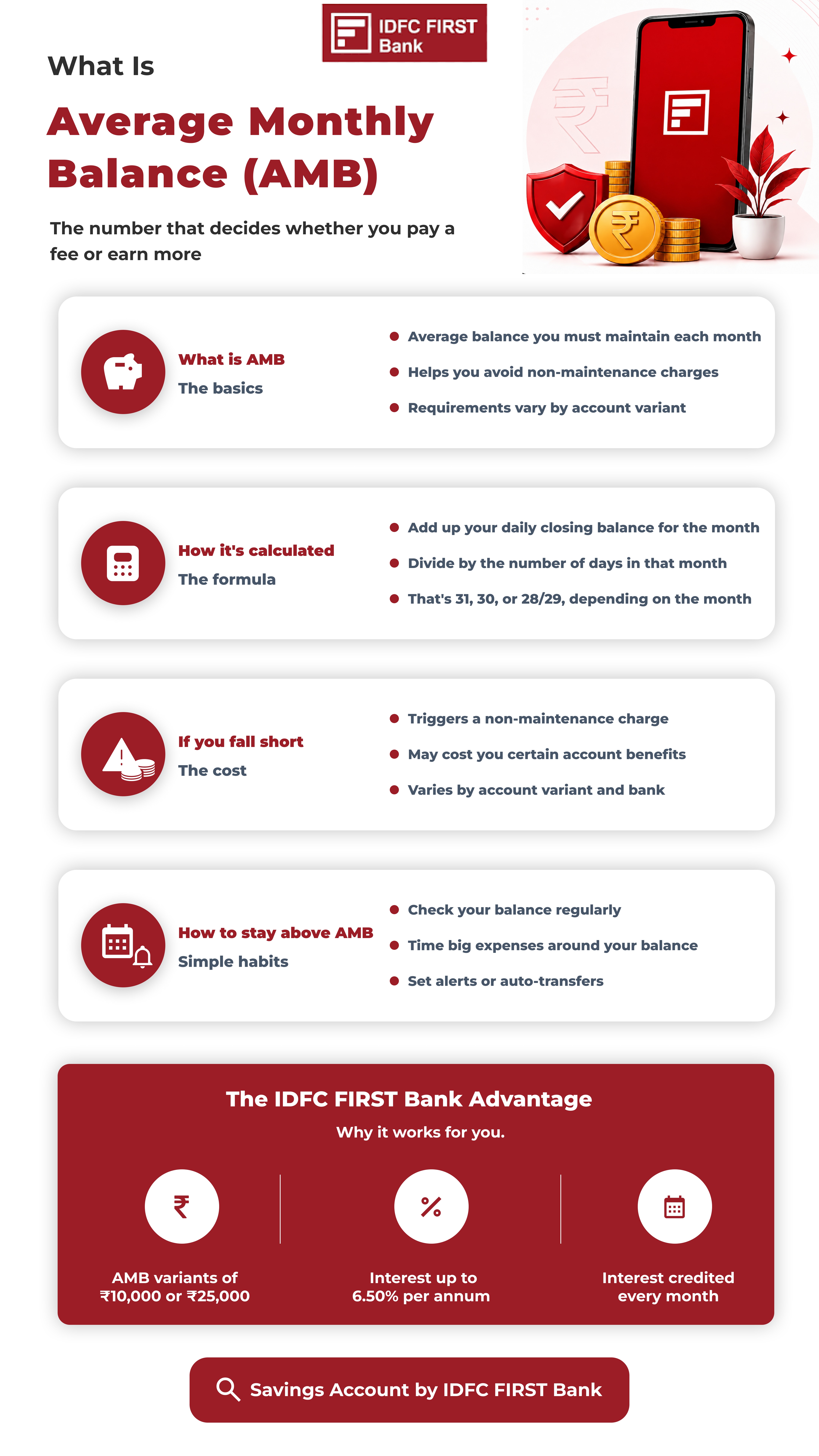
The formula is:
Monthly average balance = Total daily balances of the month / Number of days in the month
Step-by-step breakdown:
Example calculation for a 30-day month with the following balance pattern:
Days 1 to 15: Balance of ₹40,000 each day → Total: ₹40,000 × 15 = ₹6,00,000
Days 16 to 30: Deposit of ₹20,000 made on day 16, bringing balance to ₹60,000 → Total: ₹60,000 × 15 = ₹9,00,000
Sum of daily balances = ₹6,00,000 + ₹9,00,000 = ₹15,00,000
AMB = ₹15,00,000 ÷ 30 = ₹50,000
This result is the answer to the question of what the average monthly balance figure is for that month. To estimate how your balance and interest interact over time, you can use a savings account interest rate calculator.
| Parameter | Average monthly balance |
| Definition | Average of all daily closing balances across the month |
| Measurement | Calculated at the end of the month |
| Flexibility | Has flexibility as long as the month-end average meets the threshold |
| Penalty | Triggered when the month-end average falls short of the requirement |
Maintaining the required average monthly balance consistently determines the range of benefits and services the account actively offers:
Avoidance of non-maintenance charges: Falling short of the required AMB attracts penalties, which can accumulate and reduce your savings over time.
Fee waivers and service benefits: AMB maintenance may provide waivers on certain service charges.
Better savings: Keeping adequate funds in your savings account means you earn interest on those balances, which contributes to financial growth over time.
Account standing: Maintaining the required AMB keeps the account in good standing and ensures continued access to associated features and benefits.
When the required AMB is not met at month-end, the following apply:
Non-maintenance charge over time can directly reduce the net balance
Restrictions on certain service benefits tied to the account
Set up a monthly auto-transfer into your account to maintain the required AMB without manual intervention.
Maintain a higher balance than the minimum requirement to account for occasional low-balance days.
Avoid withdrawing large amounts at the beginning of the month, as this reduces the daily balance and lowers the monthly average.
Use mobile banking or SMS alerts to monitor your balance and take action.
Use a savings account interest rate calculator to plan better.
Confusing minimum balance with AMB: These are two distinct concepts. AMB allows daily fluctuations, while a minimum balance must be present at all times.
Overlooking the month-end computation date: AMB is assessed at the end of the calendar month; corrective action taken too late in the month may not be sufficient.
Not reading the bank's schedule of charges: Failing to check applicable non-maintenance charges can result in unexpected deductions.
Assuming a one-time deposit is sufficient: A large deposit followed by a large withdrawal can still result in a low average if the remaining days carry a low balance.
Ignoring scheduled debits: EMIs, utility payments, or other automatic debits on specific days can lower the balance and affect the monthly average.
Waiting until the final days of the month to act: Compensating a low balance in the last few days is less effective than maintaining a consistent daily balance throughout the month.
Understanding how to calculate the monthly average balance gives account holders direct control over whether charges are applied or benefits are retained. Tracking the balance regularly, planning withdrawals with the monthly average in mind.
AMB is calculated by adding the closing balance of the account at the end of each day of the month and dividing the total by the number of days in that month.
The bank levies a non-maintenance charge, and certain benefits may also be revoked.
AMB may apply to many savings account variants.
The contents of this article/infographic/picture/video are meant solely for information purposes. The contents are generic in nature and for informational purposes only. It is not a substitute for specific advice in your own circumstances. The information is subject to updation, completion, revision, verification and amendment and the same may change materially. The information is not intended for distribution or use by any person in any jurisdiction where such distribution or use would be contrary to law or regulation or would subject IDFC FIRST Bank or its affiliates to any licensing or registration requirements. IDFC FIRST Bank shall not be responsible for any direct/indirect loss or liability incurred by the reader for taking any financial decisions based on the contents and information mentioned. Please consult your financial advisor before making any financial decision.
The features, benefits and offers mentioned in the article are applicable as on the day of publication of this blog and is subject to change without notice. The contents herein are also subject to other product specific terms and conditions and any third party terms and conditions, as applicable. Please refer our website www.idfcfirst.bank.in for latest updates.


You will earn